
When Retail Media Has No Strategy, Execution Becomes the Strategy
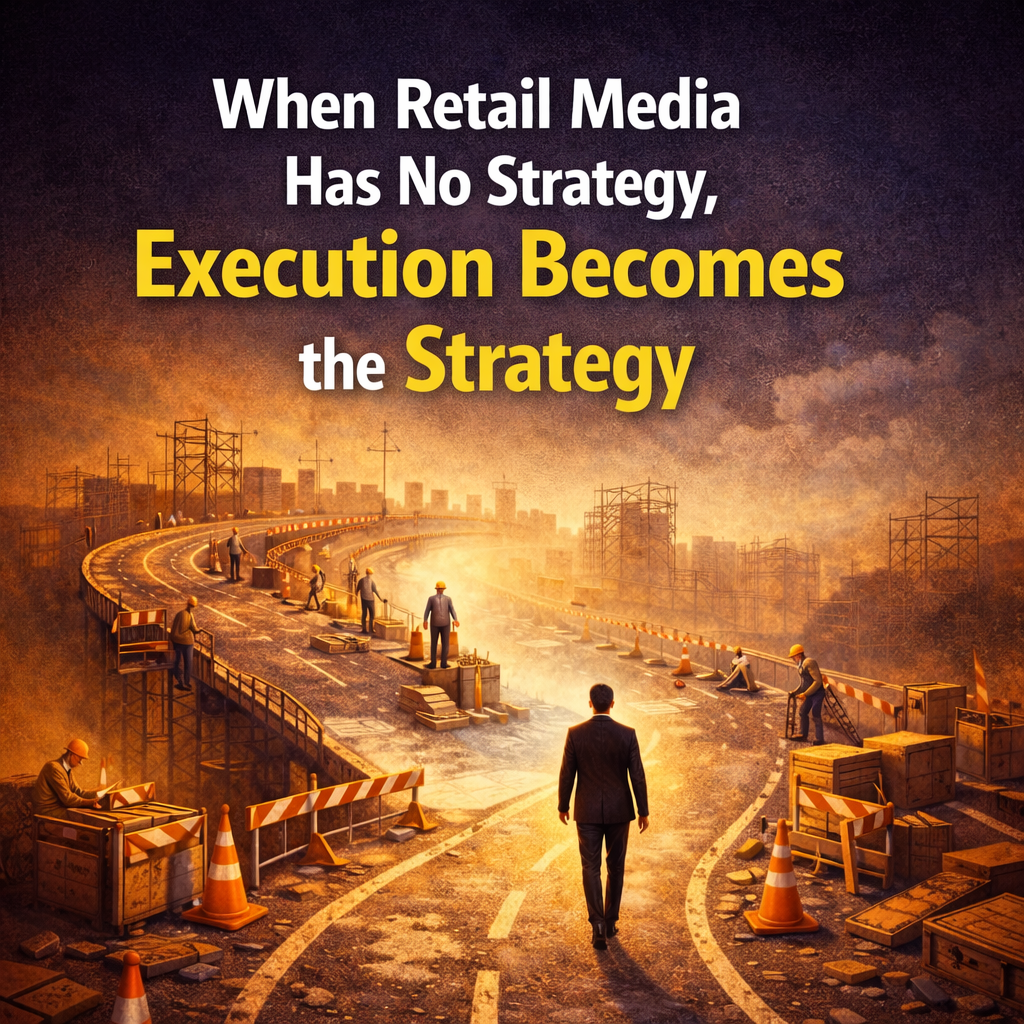
When retail media orgs are built by retail leaders, the focus often isn’t on what the business is trying to become. It’s on how things are being executed.
That might sound subtle, but it changes everything.
Instead of a strategy rooted in creativity, insight, and narrative—something that defines where we’re going and why—what takes its place is a set of tactical decisions: bundles, packages, tiers, rate cards, predefined offerings.
Those things aren’t inherently bad.
But they are not a strategy.
They’re substitutes for one.
When those elements become the foundation of the business, there’s no real direction—just motion.
From the inside, it feels like we’re building the road while driving on it.
Rather than moving toward a defined destination, we take one step forward and two steps back—constantly adjusting, reworking, re-explaining, and re-deciding things that could have been avoided if there were a real strategic frame from the start.
Without a clear strategy, everything becomes a decision.
Without a clear narrative, every choice becomes debatable.
Without a clear destination, every step feels provisional.
That’s when execution stops being the outcome of strategy—and becomes the strategy itself.
And that’s a dangerous place for any business to live.
What This Looks Like in Practice
In my current role, I see this pattern constantly.
Teams end up carrying retail process into media problems.
They optimize for organizational comfort instead of effectiveness.
They design for familiarity instead of real-world performance.
This doesn’t happen because people are incompetent.
It happens because the system rewards safety over clarity.
Retail logic favors predictability.
Media logic requires direction.
When direction is missing, the organization fills the void with process.
That’s how you get:
• Endless check-ins
• Micro-decisions
• Re-litigation of basic assumptions
• Slow movement
• Confusion about ownership
• Fatigue from constant recalibration
All of that energy goes toward compensating for the absence of strategy.
Strategy Isn’t a Deck. It’s a Compass.
A real strategy doesn’t just say what you’re doing.
It explains why you’re doing it and where it’s going.
It creates:
• Alignment
• Momentum
• Confidence
• Clear tradeoffs
Without that, every team is forced to invent meaning locally.
That’s when organizations fragment—not because people disagree, but because no one can see the whole picture.
The Question Retail Media Has to Answer
If retail media wants to be more than a monetization layer, it has to decide:
Is it building offerings?
Or is it building a business?
Those are not the same thing.
And until that question is answered, execution will keep masquerading as strategy.